_edited_edited_edited_edite.png)
Contract Law Questions - When Is a Contract Frustrated?
The contract law questions every student asks - answered.
A contract may be discharged on the ground of frustration when something occurs after the formation which renders it physically, legally or commercially impossible to fulfil the contract, or transforms the obligations into something radically different from that which was agreed at the moment the parties entered into the contract.
What Is Frustration?
One of the most commonly cited descriptions of frustration is by Lord Radcliffe in Davis Contractors Ltd v Fareham UDC [1956]:
"Frustration occurs whenever the law recognizes that without default of either party a contractual obligation has become incapable of being performed because the circumstances in which performance is called for would render it a thing radically different from that which was undertaken by the contract. It was not this that I promised to do."
Modern Test for Frustration
Generally speaking, a frustrating event is an event which (In National Carriers Ltd v Panalpina (Northern) Ltd [1981]):
Occurs after the contract has been formed.
Is so fundamental as to be regarded by the law both as striking at the root of the contract and as entirely beyond what was contemplated by the parties when they entered the contract.
Is not due to the fault of either party.
Renders further performance impossible, illegal or makes it radically different from that contemplated by the parties at the time of the contract.
The best way to understand the scope of the doctrine of frustration is by looking at decisions of the court. That said, since the doctrine of frustration depends on the construction of the obligation created by the particular contract in light of its own circumstances, reported decisions can only be a rough guide, albeit a useful one.
In Davis Contractors Ltd v Fareham Urban District Council [1956], a building contract became far more expensive and time-consuming than expected due to labour shortages. It was held that the contract had not been frustrated because performance was still possible, even though it had become more difficult and costly.
The Development of Frustration
Where did the Doctrine Come From?
As a general rule, if performance of a contract becomes difficult or even impossible, the party who fails to perform is still liable to pay damages (Paradine v Jane (1646)). This became known as the doctrine of absolute contracts.
In Paradine v Jane (1646), the tenant of a farm was sued for arrears of rent. The defendant pleaded that for part of the period to which the claim related he had been evicted and dispossessed by an alien enemy, which was beyond his control and prevented him from taking the profits of the land out of which he intended to pay the rent. The court held that the tenant was nevertheless liable for rent under the lease albeit in respect of a period he was deprived of possession of the premises by an event for which neither party was responsible.
The Development - Taylor v Caldwell
In Taylor v Caldwell [1863], a music hall was destroyed by fire before concerts could take place. It was held that the contract had been frustrated because performance had become impossible due to the destruction of the subject matter.
The court held that the defendants were not liable in damages, since the doctrine of sanctity of contracts applied only to a promise which was positive and absolute:
"The principle seems to us to be that, in contracts in which the performance depends on the continued existence of a given person or thing, a condition is implied that the impossibility of performance arising from the perishing of the person or thing shall excuse the performance."
"In none of these cases is the promise other than positive, nor is there any express stipulation that the destruction of the person or thing shall excuse the performance; but that excuse is by law implied, because from the nature of the contract it is apparent that the parties contracted on the basis of the continued existence of the particular person or chattel."
The doctrine has since been extended not only to cover situations where the physical subject matter of the contract has perished, but also where there has not been any such physical destruction (such as where the contract becomes radically different from what was initially envisaged).
Key Categories of Frustration
Destruction of Subject Matter
One of the earliest examples is Taylor v Caldwell (1863) which has been described above. Once the hall was destroyed, performance became impossible.
Cancellation of an Event
Sometimes the contract is based on a specific event occurring. If that event is cancelled, frustration may apply.
In Krell v Henry [1903], The defendant hired a room overlooking the route of King Edward VII's coronation procession. The procession was subsequently cancelled due to the King's illness. The court held that the contract was frustrated. Although the room still existed and could technically be used, the entire purpose of hiring it was to watch the coronation procession.
Supervening Illegality
A contract may be frustrated if performance subsequently becomes unlawful.
For example, suppose a company agrees to export goods to a foreign country. After the contract is formed, the government bans exports to that country. Performance has become illegal. The contract may therefore be frustrated. Courts generally have little difficulty finding frustration in cases of supervening illegality because the law cannot require parties to perform an unlawful act.
When is Frustration Not Available?
Conduct of Parties
Where the event is caused by the conduct of one of the parties, there is no frustration.
In Armchair Answercall Ltd v People in Mind Ltd [2016], the Court of Appeal refused to find that the contract had been frustrated, not only because the alleged frustrating event should have been foreseen by the parties, but also because it was partially caused by the conduct of the defendant who was seeking to rely on the doctrine.
More Expensive
Where the contract merely becomes more expensive to perform, there is no frustration (Tsakiroglou v Noblee Thorl [1962]).
The Event was Foreseeable
Courts are less likely to find frustration where the event was foreseeable. If parties could reasonably have anticipated the risk, they are expected to address it within the contract.
Consequences of Frustration
Common Law
At common law, if a contract has been frustrated it is automatically discharged and the parties are excused from their future obligations (Hirji Mulji v Cheong Yue SS Co [1926]).
Importantly, the contract is not rescinded (rescission undoes a contract as if it had never existed and restores the parties to their pre-contract positions). Instead, if a party incurred obligations before the time of frustration, it remains bound to perform them (including any payment obligations which have accrued due).
Statute
Sections 1(2) and 1(3) of the Law Reform (Frustrated Contracts) Act 1943 address the possible unfairness that the common law position can create. It provides that:
Money paid before the frustrating event can be recovered and money due before the frustrating event, but not in fact paid, ceases to be payable (section 1(2), LRA).
A party who has incurred expenses is permitted, if the court thinks fit, to retain an amount up to the value of the expenses out of any money they have been paid by the other party before frustration; or where money was due and payable at the time of frustration, recover a sum not exceeding that amount for expenses (section 1(2), LRA).
The court may require a party who has gained a valuable benefit under the contract before the frustrating event occurred, to pay a "just" sum for it. This is so whether or not anything was paid or payable before the frustrating event (section 1(3), LRA).
Example
Facts
Alice pays £2,000 to hire a wedding venue.
One week before the wedding, the venue is destroyed by fire and the contract is frustrated.
Common Law Position (Before 1943)
The venue might have been able to keep the money even though the wedding never took place.
Position Under the 1943 Act
The £2,000 is generally recoverable by Alice because it was paid before the frustrating event. However, the court may allow the venue to keep part of the money if it incurred expenses in preparation for the wedding.
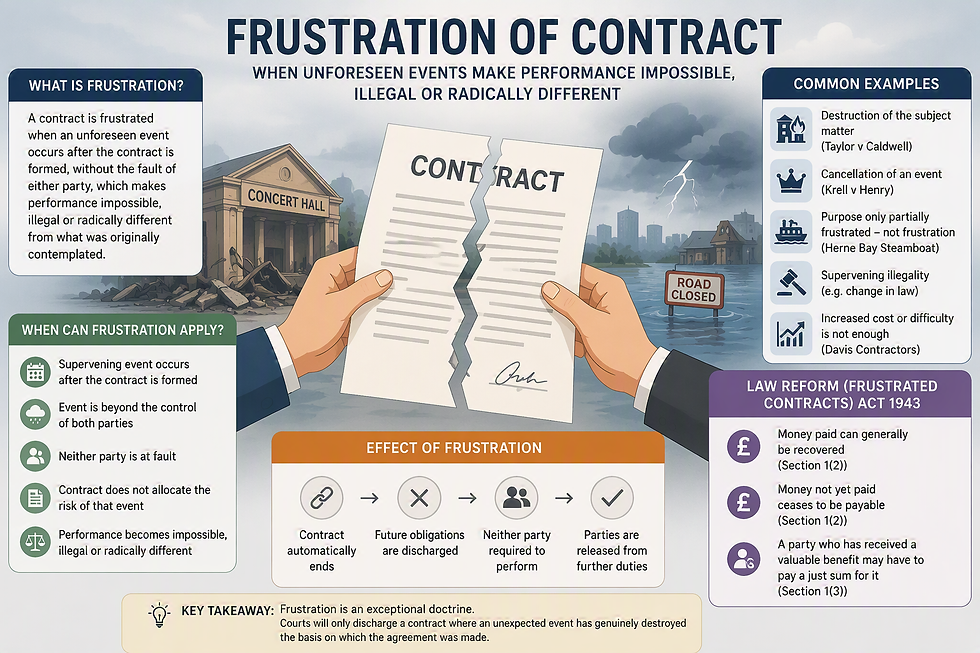
Frustration - In Summary
Key Takeaways
Frustration occurs when an unforeseen event fundamentally changes the nature of contractual obligations.
The doctrine is applied narrowly by the courts.
Increased difficulty or cost is usually insufficient.
The event must render performance impossible, illegal or radically different.
Key cases include Taylor v Caldwell, Krell v Henry, Herne Bay Steamboat, Davis Contractors, and Maritime National Fish.
A frustrated contract is automatically discharged.
Financial consequences are governed by the Law Reform (Frustrated Contracts) Act 1943.

Comments