_edited_edited_edited_edite.png)
How to Write Effective Conclusions in Law Essays: Using IRAC to Finish Strong
Introduction
One of the most common mistakes law students make is treating the conclusion as an afterthought. After spending most of their time discussing cases, statutes, and legal principles, they often finish with a brief sentence that merely repeats what has already been said.
However, a well-written conclusion can be the difference between a good essay and an excellent one. It demonstrates that you have answered the question, ties together your analysis, and leaves the marker with a clear understanding of your argument.
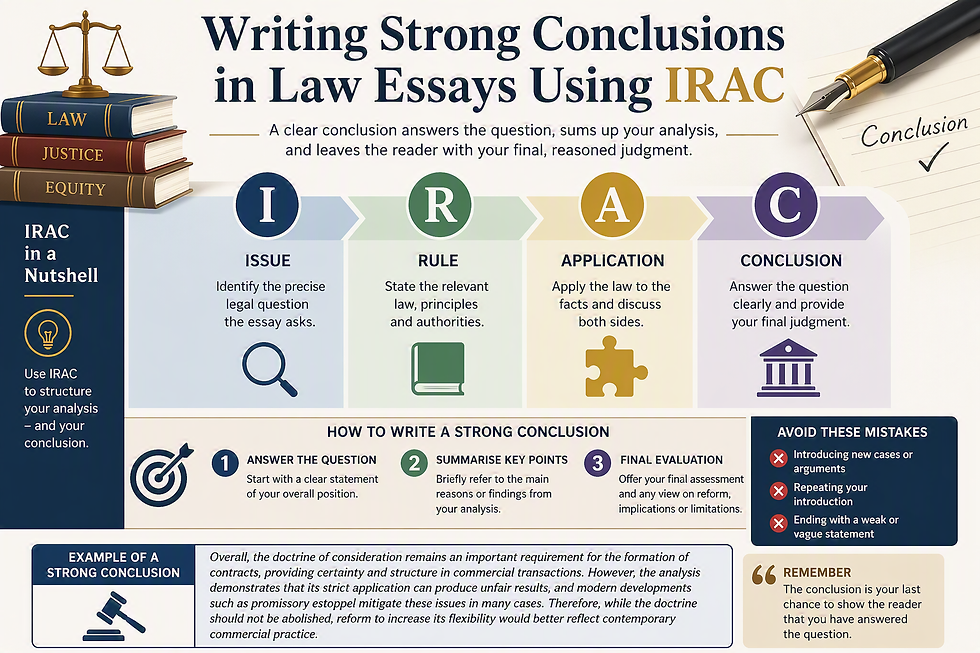
A useful way to think about conclusions is through the lens of the IRAC model (Issue, Rule, Application, Conclusion). While IRAC is most commonly associated with problem questions, its underlying logic can significantly improve essay conclusions as well. The IRAC framework emphasises that legal reasoning should end with a clear and justified conclusion rather than merely discussing the law.
You can find out more about using IRAC here.
Why Conclusions Matter
The conclusion is your final opportunity to answer the question directly. A strong conclusion should:
Answer the essay question clearly.
Draw together the main points of your analysis.
Demonstrate the significance of your argument.
Avoid introducing new authorities or arguments.
Markers are not looking for a detailed summary of every paragraph. Instead, they want evidence that you have reached a reasoned legal judgment based on the analysis presented throughout the essay.
What a Good Law Essay Conclusion Looks Like
Answer the Question Directly
The first sentence should clearly state your overall position.
💡Example: The current law on consideration remains an essential component of English contract law although, as this essay has shown, its practical significance has been reduced by the development of alternative doctrines such as promissory estoppel.
Notice that the writer immediately answers the question rather than merely announcing that they are concluding.
Draw Together Key Themes
Next, identify the most important findings from your essay.
💡Example: The analysis demonstrates that while consideration continues to provide a common law mechanism for distinguishing enforceable promises, the courts have increasingly relied upon broader principles of fairness and commercial practicality.
This reminds the reader of the central argument without repeating the entire essay.
Offer a Final Evaluation
Many law essays require critical assessment rather than simple description. The conclusion should therefore provide a final judgment:
💡Example: Although reform has frequently been proposed, the existing doctrine remains sufficiently flexible to meet the needs of modern commercial relationships.
This demonstrates independent evaluation and critical thinking.
What Not to Do
Introduce New Cases
Avoid adding authorities that have not been discussed earlier. If the case has not been analysed previously, it does not belong in the conclusion.
Repeat Your Introduction
Many students simply rephrase their introduction.
Poor Example: This essay has discussed the doctrine of consideration and several relevant cases.
This tells the marker what the essay did rather than what the essay proved.
End Abruptly
A conclusion should not consist of a single sentence or two. This lacks depth, explanation, and evaluation.
Exam/Essay Tips
Before writing your conclusion, think about a 'mini IRAC'. Ask yourself:
What issue was the essay asking me to address?
What legal rules and authorities were most significant?
What did my analysis show?
What is my final answer?
If you can answer those four questions, your conclusion will naturally reflect the IRAC process and provide the marker with a clear ending to your argument.
Example
The below is an example of a weak conclusion:
Weak Conclusion: In conclusion, this essay has discussed consideration and several important cases. The doctrine remains part of contract law and continues to be applied by the courts.
The below is an example of a strong conclusion:
Strong Conclusion: Overall, the doctrine of consideration continues to perform an important gatekeeping function by distinguishing legally enforceable promises from mere social arrangements. However, the analysis has shown that modern developments, particularly promissory estoppel and the practical benefit doctrine, have reduced its practical significance. While consideration remains a central feature of English contract law, its theoretical justification appears increasingly difficult to defend. Consequently, although the doctrine should not be abolished entirely, substantial reform may be necessary to reflect modern commercial realities.
Final Thoughts
The best law essay conclusions do not merely summarise. They resolve. Just as the conclusion in IRAC provides the ultimate answer to a legal issue, the conclusion in a law essay should provide a clear, reasoned response to the essay question.
A strong conclusion shows that you have not only understood the law but have also reached an informed legal judgment—exactly what university examiners are looking for.
Quick Recap

Comments