_edited_edited_edited_edite.png)
SQE 2 - At a Glance
What is SQE 2?
The Solicitors Qualifying Examination (SQE) is the centralised, two-part assessment required to qualify as a solicitor in England and Wales:
SQE 1: Tests Functioning Legal Knowledge (FLK). It consists of two computer-based, multiple-choice exams.
SQE 2: Tests practical legal skills and application of law and involves written and oral exams.
SQE2 is not “more SQE1”; it is a skills assessment that requires use of legal knowledge in realistic solicitor tasks. The exam combines oral performance and written solicitor tasks across 16 stations. There are 12 written stations over three consecutive days and 4 oral stations over two consecutive half-days.

How the Stations Fit Together
Each station tests a legal skill in a practice-area context. Professional conduct and ethics are assessed pervasively and may not be expressly signposted.
The skills assessed are as follows:
Skills assessed |
Client interview and attendance note/legal analysis |
Advocacy |
Case and matter analysis |
Legal research |
Legal writing and legal drafting |
The practice areas are as follows:
Practice areas |
Criminal Litigation |
Dispute Resolution |
Property Practice |
Wills and Probate |
Business organisations, rules and procedures |
Assessment Window and Schedule
The written assessments take place at Pearson VUE test centres. The oral assessments are held at oral assessment centres.

Oral Stations
The oral stations assess performance as well as legal judgment. Candidates must demonstrate professional conduct in the room and then apply the law clearly and proportionately.
Station | Timing | What assessors look for |
Client interview and attendance note/legal analysis | 10 minutes to read email/documents; 25 minutes to conduct the client interview; 25 minutes to write the attendance note/legal analysis. | Effective listening and questioning; client-appropriate explanation; professionalism, courtesy and client focus; accurate note and initial legal analysis. |
Advocacy | 45 minutes to prepare from documents; 15 minutes to make submissions to the judge. | Clear, persuasive and structured submissions; correct application of relevant law; ability to respond to judicial intervention; professional and measured delivery. |
The exam can start with either the interview and attendance note or the advocacy task. Day one will cover dispute resolution and property practice, while day two will cover criminal litigation, wills and intestacy, and probate administration and practice.
Written Stations
The written part of the exam tests whether candidates can produce usable solicitor work under time pressure. There are four written task types, assessed across twelve exercises.
Task type | Timing | Focus |
Case and matter analysis | 60 minutes | Identify issues, apply law and advise on next steps. |
Legal research | 60 minutes | Use provided materials to answer a focused legal question. |
Legal writing | 30 minutes | Write a clear, client-appropriate or professional communication. |
Legal drafting | 45 minutes | Prepare a document that works legally and practically. |
Day one will cover dispute resolution and criminal litigation, and day two will cover property practice, wills and intestacy and probate administration and practice. Day three will only cover business organisations, rules and procedures.
How SQE 2 is Marked
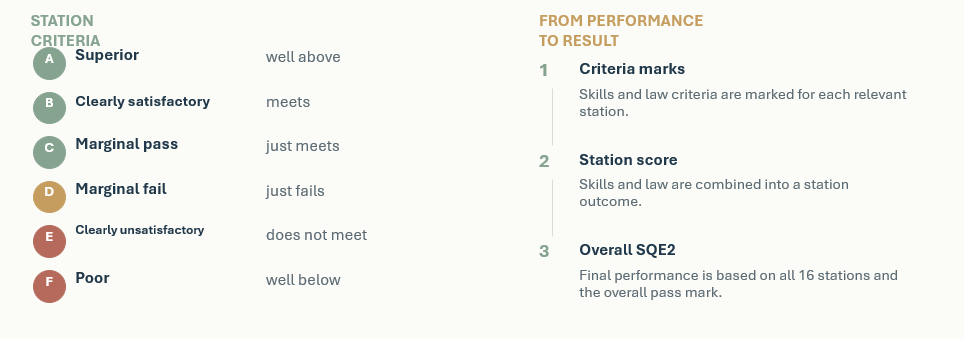
Assessors make global professional judgements against criteria, and results are then converted into marks. Skills and law criteria are marked for each relevant station, combined into a station outcome, and then considered across all 16 stations against the overall SQE2 pass mark. You can see the marking specifics here.
If you fail the exam, you will need to pay the exam fee (£2,974 for assessments up to September 2026) to retake it. However, if you fail any portion of the exam three times, you will have to wait six years from the day of your first exam to reapply.
After You Pass SQE 2
Once you pass SQE 2, you may be able to apply to the roll of solicitors. In order to apply, you will need to have completed your two years of work experience and undergo screening.

Comments